
- News
- City News
- mumbai News
- TOI confirms trees gone at Aarey site, Metro says 25 percent of work done
Trending
This story is from December 5, 2019
TOI confirms trees gone at Aarey site, Metro says 25 percent of work done
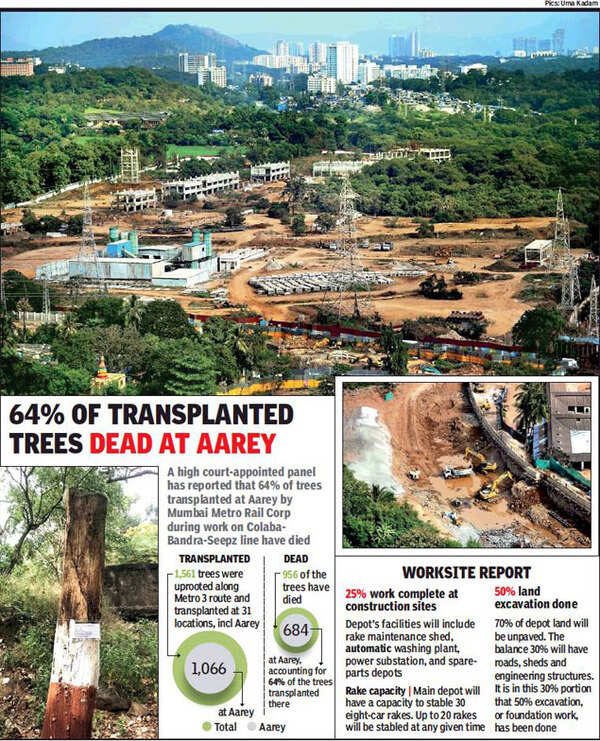
Deep inside Aarey Colony, one of the last surviving green lungs of the city, a sprawling 80-acre plot, as big as four Oval Maidans, has been turned into a high-security zone. Barricaded with metal sheets, the gates are manned by toughies — beefed-up bouncers hired privately and security guards too. A TOI team which tried to enter the site on Tuesday was told to stay off and not click pictures. This is the land where the Mumbai Metro Rail Corporation (MMRC) claimed to have cut over 2,000 trees under the cover of darkness one night in early October to set up its controversial Metro-3 car shed.
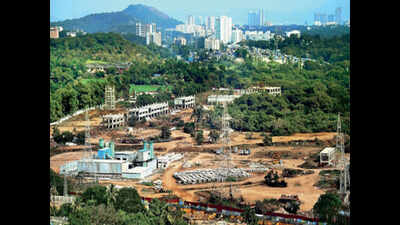
A few hundred metres from the car shed plot, the MMRC has planted new saplings and transplanted trees that were cut

Last week, the Uddhav Thackeray government finally halted work on the site, months after a major outrage which saw the police imposing curfew in the area and subsequently arresting over two dozen young activists.
On Tuesday, a request by TOI to enter the site was promptly turned down by MMRC authorities. The guards outside were instructed to shoo away people. We found posters stuck on the barricades at the entry, stating that work has been halted.
The 20-ft-high barricades ensure that no one walking or driving past can see anything inside. Near an isolated spot, where there are no guards, we stood on an elevated rock and stretched ourselves to peek inside. The vast plot of land is now almost barren: the trees are gone, although on the periphery there is some greenery. MMRC sources said 25% of work was complete at the construction site when the car shed project was halted by the chief minister. Large gantries and excavation machines now lie idle. When the state government ordered a stay, ground levelling was already underway. Also, some brick-and-mortar structures have been built at various places. There is some green patch on the fringes of the depot boundary, but MMRC sources said these were never meant to be removed. “The structures you see are for the workshop and administrative offices. Also, some work may have been done for the operation and control centre,” said a source.
MMRC expects the first rake to arrive by November 2020. Besides stabling lines, a test track is required to be built. The project will not suffer any delay in rolling out the service by December 2021 if workshops, stabling lines and the test track are ready by then.
A few hundred metres from the car shed plot, the MMRC has planted new saplings and transplanted trees that were cut. Many are dead or have wilting leaves. Every transplanted tree and sapling have been labelled by the MMRC, giving its botanical name, date of transplantation, the transplant agency and also the maintainer. Two caretakers, Sheshman Yadav and Suraj Karotiya, have been entrusted with watering the trees and saplings. Yadav said a water tanker comes to the site twice a week. “We also remove grass-like vegetation that comes in the way of the transplanted trees,” said Yadav, who is paid Rs 10,000 a month for the work.
Amrita Bhattacharjee from the Aarey Conservation Group (ACG) maintains that even though many trees might have been cut, the area continues to be a forest. “If the Metro authorities move out, the forest can regenerate itself,” she said. “This falls under the catchment area of Mithi river and needs to be protected.”
End of Article
FOLLOW US ON SOCIAL MEDIA









Photostories

Hot Picks
TOP TRENDING
Popular Categories
Hot on the Web
Top Trends
Women t20 World Cup ScenarioHaryana Election Exit PollAmethi Murder CaseJ&K Election Exit Poll ResultIsrael Iran WarRishabh PantTravis KelcesHulk HoganMohammad KaifUGC NET ResultNima Hospital Doctor MurderDiddyWomen's T20 World CupTop MBA Colleges of IndiaT20 WC ScheduleWomen T20 World Cup Points TableLive Cricket Score
Trending Topics
Samantha Ruth PrabhuNavratri Colours 2024Navratri Day 2 ColourTMKOC New SonuNaga ChaitanyaDevara CollectionGOAT OTT ReleaseRajinikanthDeepika PadukoneGovindaDevaraGovinda NewsDevara Movie ReviewHealthy RaitasSwatantrya Veer SavarkarColdplay India tour 2025Maa Durga 108 NamesNavratri JewellerySony Bravia 55 inch 4k Ultra HD TVWordle Answer
Living and entertainment
Latest News
Trump promotes fake JPMorgan endorsement, then denies involvement: 'I don't know'ISL: Borja’s left foot to Goa’s rescuePer capita income to nearly double in 5 years: Finance minister SitharamanManju Pavagada gets engaged in a close affair; pictures go viral on social mediaCommunity Connect: Hungry for connectionNFL has denied the 49ers appeal of changing their red home jerseys to white amid heatwave hitting the Santa Clara areaHaryana Assembly Elections 2024: BJP MP Naveen Jindal reaches polling station on horseSmackDown Tease Points to Possible Motor City Machine Guns WWE DebutMysuru all set for a glittering DasaraWomen's T20 World Cup scenario: What India must do to qualify for semifinals after heavy defeat in opener against New ZealandBigg Boss 18: Salman Khan begins shooting for the new season; First look from the sets revealedDrought has dried major Amazon river tributary to its lowest level in over 122 yearsJames Webb Space Telescope detects carbon dioxide and hydrogen peroxide on Pluto’s largest moon Charon; know the insightsSalman Khan's old dubsmash clip with Sonakshi Sinha cracks up the internet; fans say 'Bollywood used to be so much fun'"First murder of 2024": The Instagram post that helped Delhi Police crack Unani doctor's murderRBI: Banks should bring similar business under one entityMadhya Pradesh high court dismisses man's petition over 'objectionable' post on Lord Rama, HinduismExclusive - Omung Kumar on Bigg Boss 18 house: My inspiration came from staying in cave hotels abroad, especially in Turkey, but this set reflects our India, with its carvings, sculptures
Copyright © 2024 Bennett, Coleman & Co. Ltd. All rights reserved. For reprint rights: Times Syndication Service